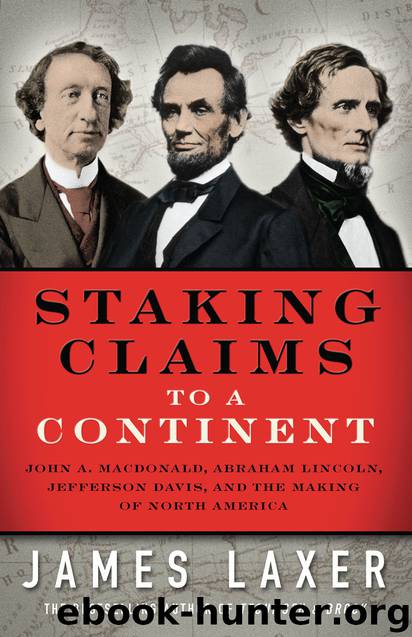
Staking Claims to a Continent by James Laxer
Author:James Laxer
Language: eng
Format: epub
Publisher: House of Anansi Press Inc
Published: 2016-06-16T15:31:36+00:00
Later that day, when the assembly met, Macdonald rose to tell the members that the governor general had agreed to a dissolution of the House, and then revealed that a discussion with the member for South Oxford, George Brown, promised a possible way ahead. At this point, many of the members erupted in loud cheering. First one member of the legislature and then a host of them rushed across the floor to shake Brown’s hand. The Rouge members from Canada East looked on in surprise and dismay. Events had passed them by.
Over the next few days, the details of the agreement between Brown and the government members were hammered out. Appropriately, George-Étienne Cartier, the key French-Canadian leader, joined the conversations, as did other members, including Étienne Taché. On the Reform side, Brown had to bear the weight of negotiating on his own.
First there was the question of whether Brown and his backers would support the ministry without joining it at the cabinet table, or whether a new coalition ministry would be formed. The Conservatives were determined that they should form a new government and that Brown had to sit on its cabinet. When Brown agreed to this, he tried to drive a hard bargain on the matter of cabinet representation for the Reformers. He argued that six of the twelve ministers should come from the Reform-Rouge side of the House. This was a non-starter, because A.-A. Dorion and the Rouges opposed the new government platform and had no intention of participating in it. Brown backed off and offered another position, which held that four of the six ministers from Canada West’s half of the cabinet should be drawn from his Reformers. That would leave John A. Macdonald with only two members.
Macdonald refused the demand and insisted that he must have three Canada West Tory seats in the cabinet. He was firm as well in demanding that he himself must retain the position of senior minister from Canada West. When Brown finally agreed to Macdonald’s position on both matters, the shape of the cabinet table in the new government was resolved. Further discussion determined that a federal state would be the goal of the new government. While Brown leaned toward beginning the federal experiment in Canada alone, Macdonald and his allies insisted on including the Atlantic provinces. And Macdonald got his way. 18
With negotiations completed on June 20, the results were presented to the Tory-Bleu and the Reform caucuses the following day. Tory-Bleu members were easily convinced. A sizeable minority of the Reformers preferred the idea of the caucus supporting the government from the outside. Most, however, agreed that it was preferable to have their members at the cabinet table. Final arguments and last-minute negotiations continued long into the night and the next morning.
On Wednesday, June 22, the assembly was not called into session until 4 p.m. When the House did begin its deliberations, a new era in Canadian history had truly begun. In English and in French, Macdonald and Cartier announced the formation of what came to be known as the Great Coalition government.
Download
This site does not store any files on its server. We only index and link to content provided by other sites. Please contact the content providers to delete copyright contents if any and email us, we'll remove relevant links or contents immediately.
| Africa | Americas |
| Arctic & Antarctica | Asia |
| Australia & Oceania | Europe |
| Middle East | Russia |
| United States | World |
| Ancient Civilizations | Military |
| Historical Study & Educational Resources |
Cat's cradle by Kurt Vonnegut(15379)
Pimp by Iceberg Slim(14534)
4 3 2 1: A Novel by Paul Auster(12411)
Underground: A Human History of the Worlds Beneath Our Feet by Will Hunt(12103)
The Radium Girls by Kate Moore(12040)
Wiseguy by Nicholas Pileggi(5798)
The Fire Next Time by James Baldwin(5458)
Perfect Rhythm by Jae(5418)
American History Stories, Volume III (Yesterday's Classics) by Pratt Mara L(5316)
Paper Towns by Green John(5200)
Pale Blue Dot by Carl Sagan(5018)
A Higher Loyalty: Truth, Lies, and Leadership by James Comey(4971)
The Mayflower and the Pilgrims' New World by Nathaniel Philbrick(4511)
The Doomsday Machine by Daniel Ellsberg(4495)
Killers of the Flower Moon: The Osage Murders and the Birth of the FBI by David Grann(4453)
The Sympathizer by Viet Thanh Nguyen(4403)
Too Much and Not the Mood by Durga Chew-Bose(4358)
The Borden Murders by Sarah Miller(4334)
Sticky Fingers by Joe Hagan(4209)
